Why Ductless AC Systems Need Different Maintenance in Connecticut
Ductless mini-split systems do excellent work in central Connecticut homes and small businesses where ductwork is limited or where zoning solves hot second floors and finished basements. They also need a different maintenance plan than a standard central AC. That difference matters in Durham, Middletown, Middlefield, Killingworth, and across Middlesex County because our climate, housing stock, and power conditions place unique stress on inverter-driven, wall-mounted equipment. Property owners searching for AC maintenance Durham CT before the cooling season want dependable cooling in July without surprise repairs in August. Getting ductless maintenance right is the most cost-effective way to get that result.
This article explains, in plain language, why ductless systems require a separate checklist, what a technician actually inspects and cleans, and what real homes on Route 17 and Route 79 experience when maintenance is skipped. It also clarifies typical 2026 Connecticut tune-up pricing so owners can plan. The focus stays practical for Durham 06422, Middletown 06457, Middlefield 06455 and Rockfall 06481, Madison 06443, Guilford 06437, Wallingford 06492, Meriden 06450, Cromwell 06416, Portland 06480, East Hampton 06424, Higganum 06441, and the surrounding towns that rely on reliable summer cooling and quick same-day service if something goes wrong.
Why ductless mini-splits behave differently than central air
Most ductless mini-splits use inverter-driven compressors. In simple terms, the outdoor unit varies compressor speed instead of switching fully on or off like a single-stage central AC. That variable speed delivers steady comfort and higher seasonal efficiency. It also shifts the maintenance focus from big, high-amperage starts to continuous, precise operation. A technician cares less about high locked-rotor amps at startup and more about steady-state amperage, board health, sensor accuracy, and clean, unrestricted airflow across compact coils.
Indoor ductless heads sit in the living space. They breathe room air directly through fine-mesh, washable filters and across a tight evaporator coil. Dust from Main Street renovations in Durham Center, pet hair in a North Madison colonial, or pollen surges near the Coginchaug River will load those filters and the coil face much faster than a conventional central air handler with a large MERV media filter. That means visible grime on louvers and a slow drop in capacity that many owners chalk up to “summer humidity,” when it is really a maintenance issue.
Drainage is different too. Each wall-mounted head removes moisture and drains through small condensate tubing that runs through walls or to a condensate pump. Algae, fine drywall dust from a remodel, or a slightly pinched tube behind a head can cause intermittent leaks on a hot Saturday in July. Maintenance for a Durham barbershop on Maple Avenue or a condo south of Wesleyan University should include a clear test of each drain and cleaning of the pan, not just a quick wipe of the cover.
Finally, most mini-splits installed through 2025 still run on R-410A refrigerant. Newer models arriving in 2025 and 2026 in Connecticut may use A2L refrigerants like R-32 or R-454B that require trained, EPA 608-certified handling and attention to manufacturer leak-detection guidance. Maintenance in the coming seasons must account for this transition. That includes making sure technicians use A2L-rated gauges and tools and verify that safety labeling remains legible and intact on newer equipment.
Connecticut homes create a specific ductless maintenance profile
Durham and Middlesex County sit in climate zone 5A. Summer design temperatures run around 86 to 88 degrees, with heavy humidity swings along the Connecticut River and near Lake Beseck. Ductless mini-splits spend long stretches running at low compressor speeds to control humidity in this part-load environment. They cannot move latent heat well with clogged filters, matted coil fins, or a dirty blower wheel. A brownish film on the coil face raises blower speed to hold setpoint, energy use rises, and condensate can blow off the coil during peak humidity on Route 9 corridor days when dew points hit 70 degrees.
Housing age drives the other part of the maintenance story. Many Durham Center and Haddam Center homes predate central AC. Ductless is the right fit because it avoids invasive ductwork and gives individual room control. Those rooms often have plaster dust inside wall cavities, older windows, and summer pollen infiltration. The indoor heads work hard to strain that particulate. A Middletown Westfield cape with a bedroom head and a first-floor head will load both indoor filters quickly in May and June. Without attention, that home will call for service in mid-July with a complaint of poor cooling upstairs. Cleaning during spring AC maintenance Durham CT removes that load before the heat wave arrives.
What a proper ductless tune-up includes in central Connecticut
A good ductless maintenance visit looks different than a central air tune-up. The work is more granular because each indoor unit is its own air handler. The outdoor unit is quieter and more sensitive to airflow, charge, and coil cleanliness. The checklist below describes the work that preserves performance and extends equipment life for a Mitsubishi M-Series, Mitsubishi H2i Hyper-Heat, Daikin Aurora, Fujitsu Halcyon, LG, or Bosch Climate 5000 system serving a Durham or Madison home.
The service starts inside. The technician removes each indoor unit’s front cover, extracts the washable screens, and vacuums or rinses them. If the coil face shows gray fuzz, they apply a coil-safe cleaner rated for aluminum and copper and rinse with care to avoid splashing electronics. Blower wheels need inspection. A layer of film on the wheel cups reduces airflow and adds noise. Cleaning the wheel restores capacity and keeps the head quiet during low-speed operation at night.
Next comes the condensate path. The technician checks the drain pan for sludge, treats with an algae inhibitor when appropriate, and verifies free flow through the gravity drain or the condensate pump. They test-pour water and confirm discharge. Intermittent head leaks on sweltering days in Madison Center almost always trace back to a partially restricted drain or a pan that was never cleaned.
Electrical and controls come next. Inverter boards, fan motors, and sensors must be checked with gentle hands. The technician verifies secure low-voltage and communication wiring at each indoor unit and at the outdoor unit. They confirm thermistor readings match room conditions. If the head believes the room is 65 when it is 72, capacity staging will be wrong. For systems with a wired or wireless wall controller, a quick calibration check keeps the setpoint honest. Where a Nest, Ecobee, Honeywell, Sensi, or American Standard AccuLink interface is in play through a ducted mini-split head, the technician confirms correct control logic and fan settings.
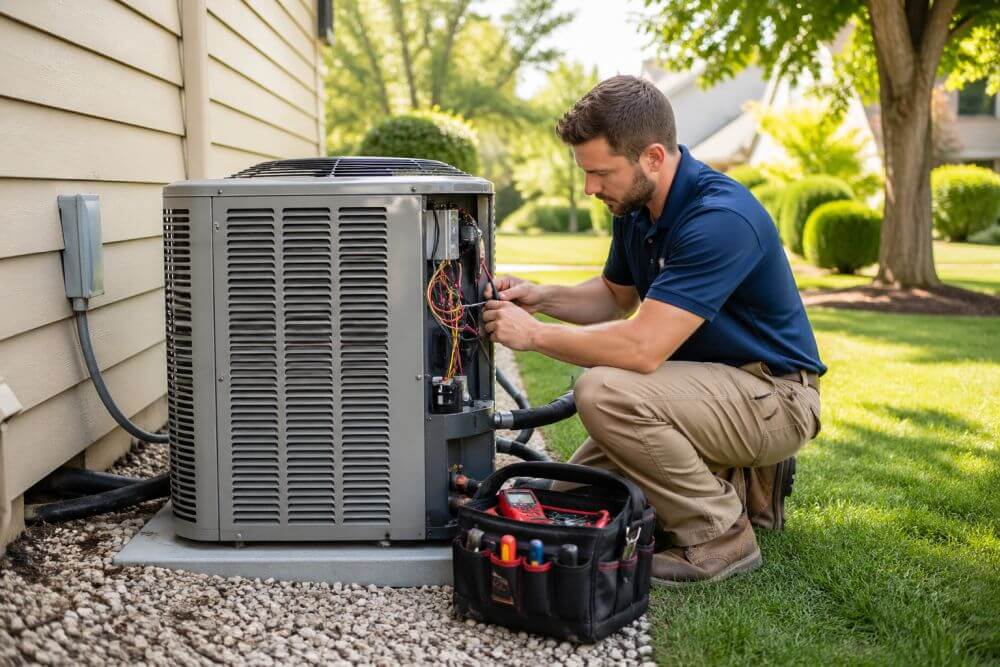
The outdoor unit demands detailed inspection. The finned condenser coil must be clean and straight. Pressure-washing at the wrong angle will fold the fins and reduce heat rejection. A careful rinse from inside out after an appropriate cleaner frees pollen and cottonwood fluff that collect in May along the Coginchaug River corridor. The technician confirms condenser fan operation, checks amperage draw under load, and inspects the cabinet for field damage from snow service or landscaping near Powder Ridge or along Route 79.
Refrigerant checks on a mini-split are surgical. Many manufacturers provide pressure and temperature service ports with guidance for subcooling and superheat targets. A mild undercharge from a slow lineset fitting leak will reduce capacity most in high heat and when multiple indoor heads call at once in a multi-zone system. The technician cross-checks pressures, line temps, and outdoor ambient to make sure charge looks healthy without unnecessary refrigerant handling. EPA 608 certification and familiarity with R-410A and the new A2Ls matter here. For systems installed in 2026 that use R-454B, the technician must use rated hoses and handle the mildly flammable refrigerant per manufacturer instruction.
Finally, the visit finishes with a run test. The technician runs each indoor unit on cooling, verifies vane movement, checks for unusual vibration, and confirms that condensate flows. On multi-zone systems with a branch box, they confirm every zone responds and that the outdoor unit ramps smoothly as heads engage.
What is different from a central AC tune-up
Central AC maintenance in a Durham ranch with a basement air handler focuses on a single blower, one evaporator, and a large condenser. Ductless flips that. Instead of a single large filter in a media cabinet, each ductless head has a small screen and sometimes a finer secondary filter. Those need cleaning more often than homeowners expect. Central AC contactors and capacitors are common failure items. Ductless systems do not rely on a big start capacitor to kick on a compressor. They use an inverter board to ramp speed. That reduces the classic failed-capacitor emergency but raises the importance of board protection, surge suppression, and correct drainage at each head.
Coil geometry differs too. Many mini-split outdoor coils wrap around three sides and use tighter fin spacing than a typical American Standard or Trane central condenser. That tighter spacing catches pollen faster. A mid-June rinse can make a five-degree difference in head discharge temperature during the first heat wave in Cheshire or Meriden.
Connecticut pricing benchmarks for 2026
Owners ask what a tune-up should cost. For AC maintenance Durham CT in 2026, a basic single-system central AC tune-up usually runs $120 to $250. A premium multi-point inspection with coil cleaning and electrical testing runs $200 to $400. Annual maintenance plans that cover both heating and cooling typically run $300 to $600 depending on equipment count.
Ductless maintenance changes the math because each indoor unit is its own air handler. Expect a base visit for a single-zone system to fall in the $150 to $300 range in central Connecticut, with multi-zone systems priced by the number of heads. Many contractors add about $60 to $120 per additional head for full cleaning and drain testing. If biological growth has built up on blower wheels or coil faces, deeper cleaning can add time and cost. Those ranges are realistic for Durham, Middletown, and Guilford in 2026 and reflect the extra indoor work required.
Why spend the money before the heat wave. A $180 to $320 spring visit often prevents a $400 to $800 in-season service event on a multi-zone system. A partially clogged drain that overflows on a Saturday can lead to drywall repair and after-hours charges. A dirty outdoor coil forces the inverter to run harder, which shortens board life. Good maintenance often pays for itself in one avoided emergency call.
What breaks when maintenance is skipped
Real failures in Middlesex County follow patterns. After dozens of summers dispatching along Route 17, Route 68, and Route 9, the following themes recur in homes and small businesses with mini-splits:
- Indoor unit leaks in July because the pan is slimed and the drain line is half-blocked, often after a spring renovation added fine dust to the air. Weak cooling during the first 90-degree week because filters and blower wheels are matted, so airflow across the coil falls and the head cannot dehumidify. Outdoor coil matted with pollen, turning the unit into a low-capacity, high-energy user during a heat advisory in Wallingford or Cromwell. Communication errors on multi-zone systems after thunderstorm surges in August on the I-91 corridor, which an inexpensive surge protector and tight wiring terminations would have prevented. Premature board failure due to heat stress in a unit that never had its outdoor coil washed or cabinet airflow kept clear.
There is another Connecticut-specific pattern worth calling out for homeowners comparing ductless to central AC. On standard central AC, roughly 70 percent of capacitor failures in Durham and Middletown cluster in the first two weeks of June and the last week of August. That is when temperature swings stress aging capacitors at startup after long off-cycles, then again as nights cool late in the season. Ductless units rarely use those large capacitors for the compressor, so that spike does not hit the same way. Instead, inverter board and sensor issues tick up during thunderstorm season in July and in late August when storms drive repeated power dips. That pattern surprises owners used to the old central AC failure curve and is one more reason AC maintenance Durham CT must include checks that suit inverter systems, not just a one-size-fits-all list.
Maintenance intervals that fit Durham and Middletown homes
For most single-family homes with one or two heads used for cooling from May to September, plan a full pre-season tune-up in April or May and one quick mid-season filter cleaning that many homeowners can handle between visits. For larger multi-zone systems used for year-round heat in a Madison addition or a finished basement in Middlefield, spring and fall professional service makes sense. That cadence keeps winter heating reliability high and summer humidity control strong.
Commercial spaces along Main Street in Durham and near Wesleyan University in Middletown often need quarterly service. Hair salons, fitness studios, and classrooms load filters fast. Evidence is on the coil face. If filters look gray two weeks after a cleaning, schedule more frequent professional cleanings. Airborne lint from a shop on Cherry Hill Road needs a maintenance answer, not a bigger system.
Technical checkpoints that protect inverter-driven equipment
Inverter-driven mini-splits respond to a tight cluster of sensors and electronics. A strong AC maintenance Durham CT visit in our market checks these details carefully and explains the findings in clear terms:
Refrigerant charge: Mini-splits use a factory charge plus an added amount per foot of lineset. An undercharge from a slow flare fitting leak hurts most when multiple heads run together. A technician checks superheat and subcooling against the manufacturer’s chart for the outdoor unit and ambient temperature. The goal is to confirm healthy charge without venting or overfilling. R-410A systems remain common, but newer R-32 and R-454B units require A2L-rated tools and careful recovery. EPA 608 certification is not optional.
Electrical integrity: On a central AC, the technician often replaces a pitted contactor or a weak run capacitor. A ductless system relies on clean, tight low-voltage communications and power to the inverter board. The board creates a high-frequency output to the compressor. Loose terminations at the outdoor disconnect or water intrusion at the indoor head wiring chase can cause intermittent faults during summer thunderstorms. A good maintenance visit torques connections and keeps wiring dry and secure.
Condenser coil condition: Wraparound coils with tight fin spacing clog with spring pollen. An inside-out rinse after foaming cleaner restores heat rejection. That work should be gentle. Bent fins block airflow. If a homeowner power-washes at an angle, the coil may need a fin comb and a careful reset.
Indoor coil and blower: The combination of tight coil fins and a small blower wheel makes cleanliness essential. Cleaning restores airflow, reduces fan noise, and improves dehumidification. It also cuts energy use because the inverter does not need to ramp higher to hold setpoint.
Controls and calibration: Many homeowners run mini-splits strictly from the handheld remote. Others tie ducted heads to Nest or Ecobee thermostats. The control must be set to cooling with appropriate fan logic. A technician confirms the sensor reads the room correctly. If the head thinks the space is cooler than it is because a TV or a floor lamp nearby adds local heat, the setpoint will drift from reality. Small adjustments during the visit prevent callbacks in June.
Durham and Middlesex County examples
Consider a 1958 split-level off Tuttle Road in Durham North that uses a two-head Mitsubishi M-Series for the second floor and a finished basement office. In May, the homeowner schedules AC maintenance Durham CT. Filters come out black. The upstairs head shows algae in the drain pan and a follow this link faint water stain on the wall. The outdoor coil is packed with spring pollen. The technician cleans both heads thoroughly, treats the drain, and washes the outdoor coil. During the July heat wave, the bedrooms hold 72 without the midnight beeping that had led to a service call the previous summer. The homeowner saves an after-hours fee and a drywall patch.
Now picture a small professional office near the Durham Fair Grounds with three wall-mounted Daikin heads. Each serves a closed-door room. Without maintenance, each indoor unit cycles at high speed to chase setpoint in humid weather. Filters load with fine dust from file storage. Staff complain about noise and warm afternoons. A quarterly cleaning plan settles the system. With clean wheels and coils, each head runs at lower speed. Noise falls. The rooms actually reach setpoint. Energy use drops compared to the previous summer, which staff notice on the bill.
Finally, think of a Middletown rental near South Farms with a four-head multi-zone system. It runs year-round. Tenants do not clean filters. In February, the heads trip defrost more often than expected. By May, two heads blow lukewarm air. A maintenance visit finds dirty indoor coils, a slightly undercharged outdoor unit, and multiple loose low-voltage terminations at the branch box. With those items corrected and a schedule set for spring and fall service, the system returns to steady operation. The property manager gets fewer summer calls and winter complaints.
How Connecticut’s refrigerant transition shows up in maintenance
The federal refrigerant transition accelerates through 2025 and 2026. Homeowners in Durham, Wallingford, or Killingworth may own R-410A ductless units today while new replacements ship with A2L refrigerants like R-32 or R-454B. Maintenance will span both types for years. The service difference is mostly about tools and safety practices. A2Ls are mildly flammable. Technicians must use rated hoses, keep ignition sources away, and follow the manufacturer’s leak-check guidance. Homeowners may notice different service labels on outdoor units and a clear A2L mark. For owners, the main practical implication is simple. Hire a contractor with EPA 608 certification and current training who documents any refrigerant work performed. That discipline protects warranty and safety.
What manufacturers matter in our market
Mitsubishi Electric leads the ductless segment in our region, with M-Series and H2i Hyper-Heat systems that hold strong capacity in cold weather. Daikin, Fujitsu, LG, and Bosch also have strong placements. Many homes pair ductless with a central American Standard, Trane, Carrier, Lennox, Bryant, Rheem, or Goodman central AC or furnace. In that mix, the maintenance standards differ by unit. For example, an American Standard Customer Care Dealer will hold to manufacturer specs on both central and ductless gear. That means paying attention to SEER2-rated airflow on ducted heads, AccuLink or other communicating thermostat logic on hybrid systems, and correct R-410A or R-454B handling at the condenser.
Why spring is the right time in Durham
Durham’s service calendar is predictable. Warm days arrive in late April. The first string of humid days tends to land in June. From a field data standpoint, the first stretch of June and the last week of August see the heaviest volume of capacitor failures on conventional AC in Durham and Middletown. That surge ties up call boards across Route 17 and Route 68. Homeowners who complete AC maintenance Durham CT on ductless equipment before Memorial Day ride out the rush. The units run cleaner, drier, and quieter. If a part is weakening, the technician catches it in May when parts are available and schedules are lighter.
Ductless versus ducted maintenance timing in older homes
Older Connecticut homes along Higganum Road or within Durham Center Historic District often use ductless upstairs and a ducted system downstairs or an oil boiler for heat. Maintenance planning should reflect that split. The ductless heads used for summer-only cooling upstairs can be serviced once each spring, with a quick mid-season filter rinse by the homeowner. The downstairs central AC or hydro-air coil should be tuned in the same visit. If a cold-climate heat pump supports winter at the same outdoor unit, schedule a fall check in addition to spring. That pattern catches defrost sensor issues and keeps winter performance at design temperatures near 0 degrees.
What property managers and commercial owners should add
For multifamily and light commercial buildings in Meriden, Cromwell, or Portland, policy matters as much as coil cleaner. Post simple filter cleaning instructions in tenant welcome packets. Tie maintenance to lease renewals. Label each indoor unit by zone. Keep a log of work done at each head. That level of recordkeeping reduces scattered callbacks and lets the technician see which units load fastest. Often, the front office near the door on Main Street accumulates grit faster than rooms at the building’s rear. Adjust the service interval accordingly.
How ductless maintenance protects efficiency ratings
SEER2 replaced SEER as the federal efficiency metric in 2023. Ductless systems with high SEER2 numbers hit those ratings under controlled test conditions with clean coils and filters. Field conditions shave performance down when airflow drops. A clogged filter in a wall-mounted head can turn a SEER2 20 system into the energy profile of a much lower-rated unit. Regular AC maintenance Durham CT preserves the efficiency buyers paid for. It also keeps dehumidification strong on those sticky July nights after a thunderstorm rolls over the Connecticut River.
How to think about upgrades discovered during maintenance
Sometimes a spring visit uncovers a bigger question. Maybe a 12-year-old outdoor unit has a failing fan motor and the multi-zone capacity no longer fits a renovated space in Guilford. Maybe the central AC in the main level ranch is aging while the ductless upstairs is in great shape. In those cases, owners weigh repair against replacement. In 2026, Energize CT and Eversource rebates apply to high-efficiency heat pumps and certain ductless installations, not general maintenance. If a homeowner in Durham 06422 decides to add a new ductless zone or take a step toward a cold-climate heat pump conversion, the rebate stack can shift the numbers. For whole-home cold-climate heat pumps, typical incentives run $1,500 to $7,500 for qualifying installations. Federal Inflation Reduction Act 25C credits can add up to $2,000 for heat pumps and up to $600 for certain controls. Those incentives do not change a tune-up invoice today but should be on the table when a system crosses the repair-replace line.
Why local licensing and dispatch capacity matter
Connecticut requires licensed HVAC contractors for cooling work. The S-1 unlimited heating and cooling license signals the ability to work on any HVAC system statewide. In practice, that means the team arriving in Higganum or Rockfall is trained to service inverter-driven ductless systems, central AC with communicating controls, gas furnaces, boilers, and heat pumps. It also means the company can dispatch during high-volume periods. Durham’s location near Route 17 and Route 79 puts service trucks within minutes of Middletown, Middlefield, and Killingworth. During a heat wave, that proximity matters when a condensate drain in a bedroom head starts to drip after 6 pm.
Two quick myths to retire in central Connecticut
Myth one: ductless systems do not need the same maintenance attention as central AC because they are inside and look clean. Reality in Durham and Madison says otherwise. The fine-mesh filters catch visible dust but allow finer particles to settle on the evaporator and blower wheel. Without cleaning, capacity slides and energy use jumps even if the face of the unit looks tidy.
Myth two: maintenance is just a filter rinse. A strong AC maintenance Durham CT visit combines cleaning with measured verification. That means amperage checks, temperature splits, communication wire integrity, drain tests, and outdoor coil work. It stops failures before they strand a family on a 90-degree night.
What owners should expect after a correct ductless tune-up
After a thorough visit, owners notice three things. First, indoor heads run at lower fan speeds more of the time. That means quieter operation in bedrooms on Pickett Lane and living rooms near Allyn Brook Park. Second, humidity falls faster on muggy days. Clean coils remove moisture better. Third, the outdoor unit ramps with fewer long, high-speed runs during afternoon heat. That translates to steadier comfort and lower bills.
A note on indoor air quality add-ons that pair well with ductless
Ductless systems do not use large central filters by default. Homes with pets, allergies, or frequent renovations may see benefits from added indoor air quality solutions. Whole-home media filtration works best on ducted systems, but there are options. A stand-alone HEPA unit in a high-use room, a UV-C light in a ducted head, or an ERV for better ventilation in tight new construction near North Madison can support cleaner indoor air. Where a home pairs a ducted main level with ductless upstairs, an Aprilaire or similar media cabinet on the ducted system can capture a significant share of household particulate. That reduces what lands on upstairs heads too.
Service discipline that holds up across brands
Whether the outdoor unit says Mitsubishi, Daikin, Fujitsu, LG, Bosch, or American Standard, inverter logic and compact indoor coils demand the same fundamentals. Keep coils and blowers clean. Confirm drains are clear. Verify charge and electrical integrity. Confirm controls. Those four items prevent most seasonal complaints in Durham, Middletown, and Wallingford. The rest is brand nuance and parts availability. A contractor authorized or experienced across American Standard, Trane, Carrier, Lennox, Bryant, Rheem, and Goodman central systems often brings the documentation habit that keeps mixed-system houses running smoothly.
Why map-pack focused maintenance pages mention roads and zip codes
Owners use search phrasing that sounds like their daily life. AC maintenance Durham CT, Middletown AC tune-up near Route 9, or ductless service 06422 are common. Location clarity helps match a service visit to an actual street and a time window that fits a family schedule. A contractor based at 57 Ozick Dr Suite i in Durham with trucks moving along Route 17 and Route 68 can actually offer same-day support across Cheshire, Meriden, and Cromwell during a heat wave. That is not a marketing line. It is a dispatch reality born of geography.
When a maintenance visit becomes a safety call
Cooling equipment is not life-safety equipment in the same way a winter heating system is at 0 degrees. Still, leaking indoor heads over electrical outlets or soaked drywall, failed condensate pumps in crowded basements, and intermittent breaker trips at the outdoor disconnect deserve urgency. During AC maintenance Durham CT, a technician who spots a compromised drain, a frayed wire jacket, or heat-stressed board capacitors in the inverter section should recommend immediate correction and explain the why in practical terms. That habit saves property damage and avoids late-night calls when supply houses are closed.
Simple economics that favor maintenance
The math is straightforward. A $180 to $320 spring ductless tune-up for a two-head system in Durham removes grime that would drive a complaint in July. That avoided call often costs $250 to $400 in the afternoon and runs higher after hours. Add the soft costs of time off work and the stress of a warm home at night. Meanwhile, clean coils and correct charge hold SEER2 efficiency that shaves summer bills in Wallingford or Madison. Year after year, maintenance is the smallest HVAC line item that prevents the most aggravation.
Ready for a precise, local ductless tune-up
Homeowners and property managers ready to schedule AC maintenance Durham CT for ductless mini-splits can book a spring visit that focuses on the details that matter in Middlesex County’s climate. Expect indoor head cleaning, condensate testing, outdoor coil washing, refrigerant verification, and controls calibration done by a Connecticut Licensed HVAC Contractor under an S-1 unlimited license. Direct Home Services operates from 57 Ozick Dr Suite i in Durham 06422 with a Monday through Saturday 24-hour operational schedule for central Connecticut. The team services Mitsubishi Electric, Daikin, Fujitsu, LG, Bosch, American Standard, Trane, Carrier, Lennox, Bryant, Rheem, and Goodman systems across Durham, Middletown, Middlefield, Killingworth, Haddam, Madison, Guilford, Wallingford, Cheshire, Meriden, Cromwell, Portland, East Hampton, Higganum, and Rockfall, dispatching along Route 17, Route 79, Route 68, Route 147, Route 9, and I-91. Annual maintenance plans run $300 to $600 and can cover both cooling and heating. Free in-home estimates and transparent written quotes are standard. To schedule ductless AC maintenance that fits Connecticut homes and the 2026 refrigerant landscape, call +1 860-339-6001 or visit https://directhomecanhelp.com/durham-ct/ac-maintenance/. EPA 608-certified and NATE-certified technicians complete the work. Where a system shows replacement economics, the team can also coordinate Energize CT and Eversource rebates and confirm Federal IRA 25C tax credit eligibility. One call secures the ductless tune-up that keeps bedrooms cool through August.
Direct Home Services provides professional HVAC repair, replacement, and emergency plumbing services in Durham, CT. Our local team serves residential and commercial clients across Middlesex, Hartford, New Haven, and Tolland counties with high-efficiency heating, cooling, and drainage solutions. We specialize in rapid furnace repair, air conditioning installation, and expert drain cleaning to ensure your home remains comfortable and functional year-round. As a trusted local contractor, we prioritize technical precision and transparent pricing on every service call. If you are looking for an HVAC contractor or plumber near me in Durham or the surrounding Connecticut communities, Direct Home Services is available 24/7 to assist.
Direct Home Services
57 Ozick Dr Suite i
Durham,
CT
06422,
USA
Phone: (860) 339-6001
Website: https://directhomecanhelp.com/
Social Media: Facebook | Instagram
Map: Google Maps